Conditions of the Siamese POW camps
The Narrow Road to the Deep NorthConditions of the Siamese POW camps were defined by forced labor, deprivation, disease, and the Japanese demand that the Death Railway be completed regardless of the human cost. The novel follows Australian prisoners whose bodies and labor were treated as resources for the railway, while showing how Dorrigo Evans and the men around him tried to preserve life, responsibility, and a shared identity inside a system designed to spend them.
Scale and setting of captivity
The railway’s construction arose from the Japanese Empire’s need to move men and supplies overland as it lost control of the seas and sought to secure its forces in Burma. The novel sets the prisoners’ experience against the scale of that project: twenty-two thousand Australian POWs were among the captives, and nine thousand were sent to work on the railway. Allied POWs were only part of the labor force. Around a quarter of a million Asian laborers, including Tamils, Chinese, Javanese, Malayans, Thais, and Burmese, also worked on it. Estimates of deaths among these laborers vary widely, from 50,000 to 200,000, and the book stresses that no reliable total is known.
Evans’ J Force reached the railway after a punishing journey from Changi. The men were crowded twenty-seven to a closed rice wagon, with too little room to sit. Their five-day trip brought no food; three men died before the survivors were taken off the train at Ban Pong and crowded into trucks for the onward journey. The journey’s physical conditions announced the camp’s larger logic: the prisoners were transported and handled as a workforce, not as people whose health or comfort constrained the railway’s demands.
The railway was completed in 1943. When locomotive C 5631 travelled its length on 25 October, the novel places the official achievement beside the human cost: the line passed countless graves, including the remains of one in three of the Australian POWs described as having worked on it. The public commemoration of the locomotive does not record the railway’s horror or name the many people who died building it. That omission extends the camps’ violence into the postwar keeping of memory.
Work, deprivation, and disease
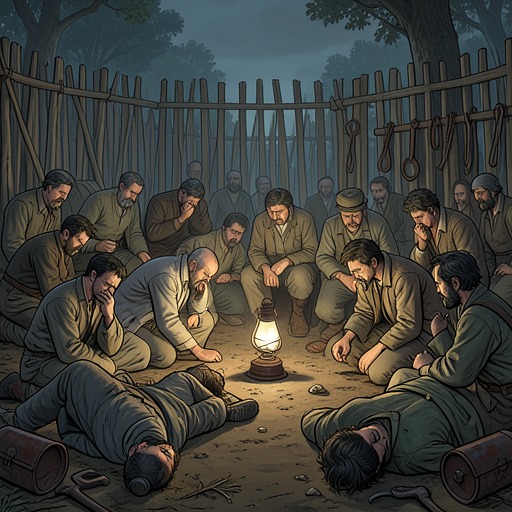
As the monsoon arrived, food diminished and the prisoners at first welcomed the rain without understanding what it presaged. Then the Speedo began. Rest days disappeared, work quotas rose, and shifts lengthened until men could be ordered to work both day and night. The distinction between the fit and the sick broke down; the remaining categories were increasingly the sick, the very sick, and the dying. Prisoners cleared jungle, broke rock, moved earth, and carried sleepers and rails with ropes, poles, hammers, bars, baskets, and hoes. They were starved, beaten, and worked beyond exhaustion.
Disease compounded the labor regime. Cholera and severe illness filled the camp’s medical facilities, while quinine and malaria further weakened prisoners and distorted their sense of time. The hospital hut offered little more than a place for the worst cases to lie. Deaths accumulated without a dependable count: the narrative registers three in one week, eight in the next, and more that could not be reckoned. Food and rest narrowed the men’s attention because other needs had been stripped away.
Small, intermittent resources helped sustain them without changing the conditions that threatened them. An occasional duck egg, a little palm sugar, and a joke repeated until it became precious offered brief support. The men continued to curse and joke, and they clung to the belief that survival was shared rather than individual. These acts of mutual recognition mattered precisely because the camp reduced daily life to labor, illness, and the search for food.
Medical judgment under coercion
The camp’s labor demands turned medical assessment into a negotiation over how many sick men could be sent to work. During one count, Dorrigo Evans, acting as both commanding officer and senior medical officer, reported that four prisoners had died the previous day and two overnight, leaving 838. Of these, 67 had cholera, 179 were in hospital with severe illness, 167 could manage only light duties, and 62 more had reported sick that morning. Evans calculated that 363 men were available for railway work.
Major Nakamura pressed for a larger number. After further argument, Evans offered 400, using his medical knowledge to judge which men might work without making the camp’s condition worse. He knew that this expertise could not protect the prisoners from the demand. Nakamura struck him while he supported a sick man; once the blows stopped, the two men resumed their silent contest before bargaining began again. Evans privately understood that the real number of men fit for the expected labor was zero. The number he had to produce was instead a grim estimate of which men were least likely to die, and that calculation had to be made again each day.
The railway’s command structure made this coercion explicit. Colonel Kota told Nakamura that the work had to be completed even if most of the laborers died, or if everyone died. In that reasoning, a POW was treated as material for the railway, comparable to its sleepers and rails. Nakamura recognized the human consequences yet persisted because the Emperor had ordered the railway and he believed there was no other way to build it. The camp’s labor system thus converted obedience into a defense of a project whose cost was borne by people denied meaningful choice.
Selection and the burden of survival
One night, Nakamura ordered Evans to select one hundred men from the prisoners for a march of one hundred miles to another camp deeper in the jungle. Seven hundred men assembled, many of them shaking with malaria or otherwise gravely ill. After confusion over the count, Evans had to choose those he judged most likely to endure the march, though he knew that they might still die. He walked the ranks, looking for the limited signs that might distinguish a man able to go from one who could not. Chum Fahey, whose condition Evans observed, was among those he refused to select.
Evans understood the selection not as a fair test of fitness but as an imposed decision among men whom he had tried to nurse and protect. He thought of Jack Rainbow and Darky Gardiner, whose suffering and deaths had already exposed the limits of his ability to save them. When he had made his choices, he lowered his head in shame. The men he had selected gathered around him; he had expected anger, but Jimmy Bigelow stepped forward. The moment does not undo the coercion or the danger of the march. It shows instead how responsibility and comradeship remained present even when the available choices were all shaped by the camp’s violence.
Shared identity and historical memory
The prisoners’ shared identity outlasted the steady reduction in their number. Evans’ J Force remained Evans’ J Force in the narrative even as men died: its identity rested on the survivors’ belief in one another and on their refusal to let the dead become irrelevant to the living. This solidarity offered no escape from forced labor, but it gave survival a social meaning the camp’s calculations could not entirely erase.
The novel sets that remembered community against the incomplete record of the railway. The plaque before C 5631 omits the suffering of the POWs and the deaths of the Asian laborers; the number of the latter who died remains unresolved, and their names are forgotten. By placing camp experience beside that public silence, the account treats remembrance as part of the history of captivity. The railway’s completion can be counted and celebrated, while many of the people whose labor made it possible remain uncounted. The prisoners’ insistence that they were still one community becomes a counter-record to that erasure.